

2. Panther Mountain
Catskills 3500

Standing On The Moon by Grateful Dead
29 June 2022
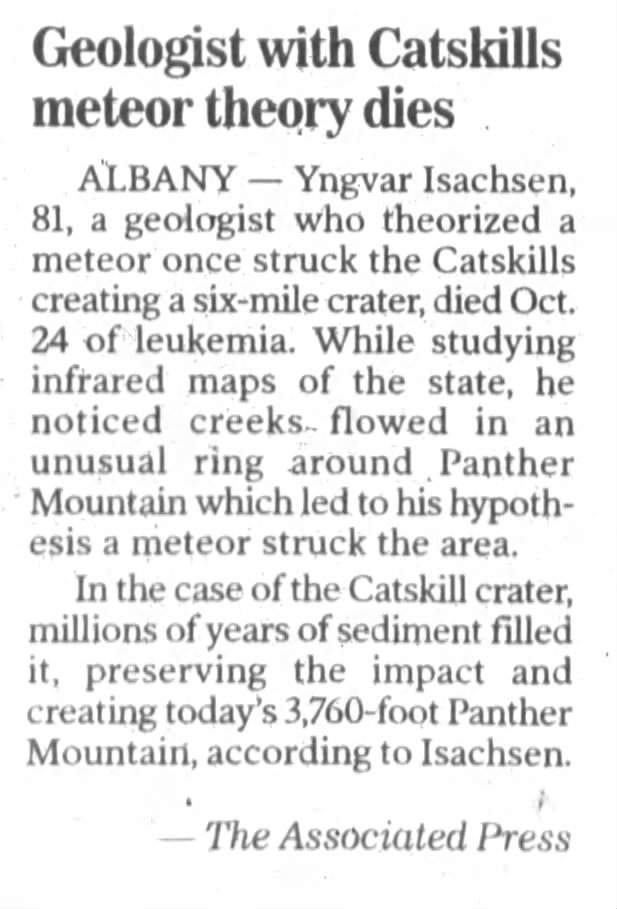
In March 2000, Ingvar Isachsen and his team set off a bunch of explosions on Panther Mountain. Isachsen, a researcher at the New York State Geological Survey, was trying to prove that a meteor impact created the site of Panther Mountain. They'd take soundings of the vibrations from the explosions. If the microphones they strung up on the side of the mountain detected the shockwaves, it would strengthen his hypothesis.
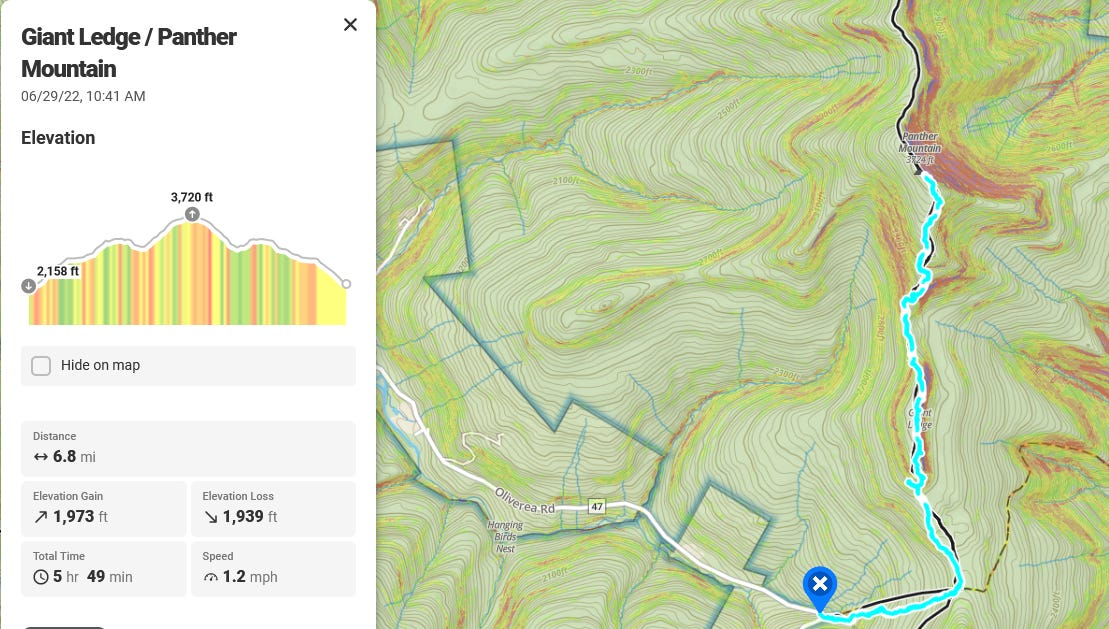
In June 2022, I climbed that same mountain, utterly oblivious to the unique geology underneath me.

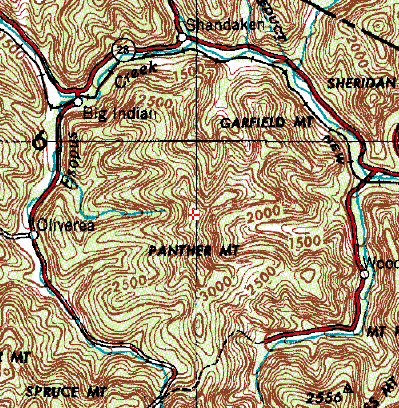
In 1970, the geologist studying a topographic map noticed something strange. The Esopus and its tributary, Woodland Creek, made a circle around Panther Mountain, while creeks everywhere else in the Catskills normally meander and roam. The image looks like an outline of a crater. Isachsen would return for further study when he could, given his busy day job. The crater would have to wait.
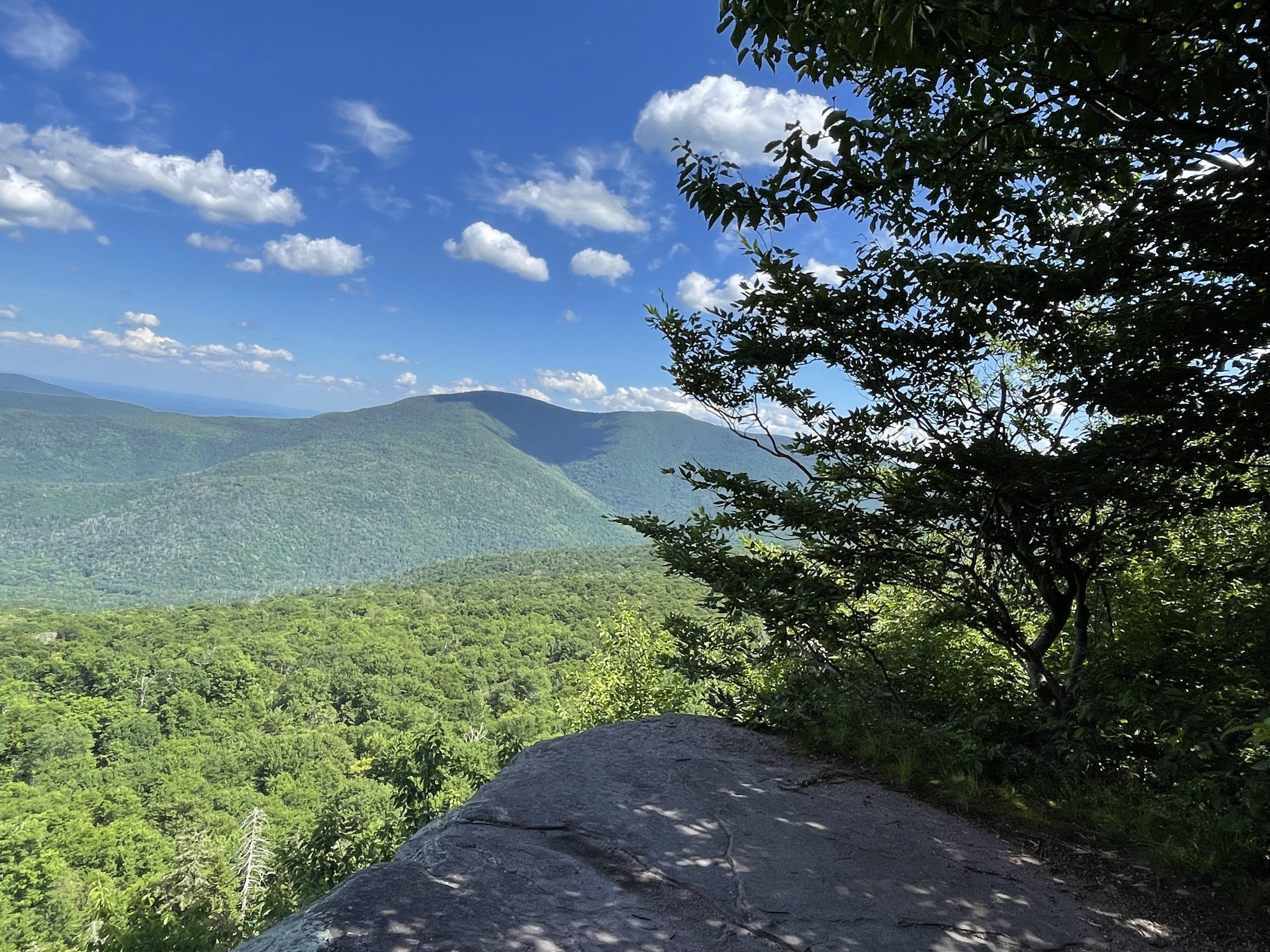
The Giant Ledge is a breathtaking overlook along the trail to Panther Mountain. This place is renowned for its short hike and magnificent panoramas. It took my breath away. The first time I saw it, I physically gasped. I'll stop again on the way down to spend quality time with the Ledge. I headed to the summit.
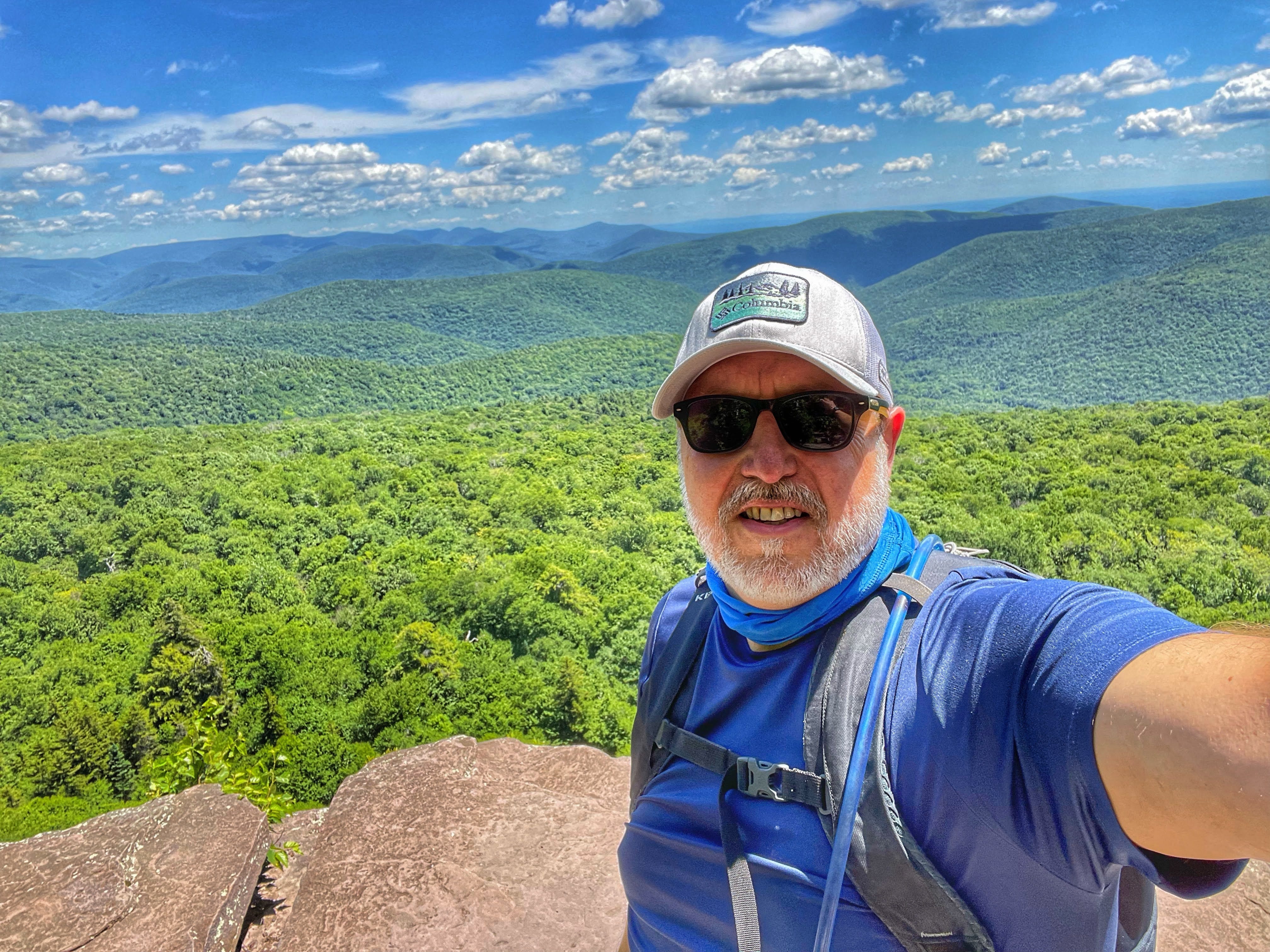
The climb was steep, but nothing new. Six hundred vertical feet and 1.5 miles later I was standing at the top of Panther. The peak offered a limited view. This will become a recurring theme for this challenge. Many high peaks in the Catskills offer reduced views from the top. Not that you can write a nice cheery letter home about, anyway. So, when one appears, I should grab it like a greedy kid grabs the last candy bar. The first couple of hikes spoiled me view-wise. You don't know what you don't know.
In 1993, Yngvar Isachsen returned his attention to the Panther crater. His work with the state nearing its end, he could now direct his energy towards the thing that dominated his thoughts. The team had taken samples and inspected them painstakingly. Melted quartz found in some sections of crystal, normally formed from the shock of a meteor impact, gave them a reason to continue. He hiked over the mountain several times, taking precise elevation measurements. He realized that to prove his hypothesis, he'd need core samples from deep below the mountain. The kind that oil companies routinely extract.
George Chadwick was a geologist in the 1940s that took an interest in the odd circular valley surrounding Panther. He thought natural gas pushing up from the core caused it. Isachsen then learned of the Dome Oil Company. They had drilled a well into the mountain and were producing a small amount of natural gas. The volume generated wasn't profitable, so they abandoned the project. The leftovers from the drilling ended up in the New York State Geological Survey Museum, where Isachsen and Geology graduate students carefully examined each bag, grain by grain. This might be the evidence he needed.
Back on the Giant Ledge, I sat down to lunch. The view more than made up for the trek up and down the mountain. My former hiking buddy would always complain about hiking but loved the beautiful views at the end. What was before me was my reward. I didn't hate the trekking part. There was more to it than just physical effort. Something more was being offered. I'd think about this more as I climbed other mountains. There was something beyond mere sweat and labor involved. Sitting on the ledge, I witnessed a whole new perspective of the world. Mountains and trees and clouds and sky. It was endless. It was exquisite. At that moment, I felt right-sized. Like I realized my proper place in this enormity. People refer to this by different names. The universe. Eternity. God. With the wind whistling below, it looked like the trees were breathing. Every single thing at once, at one.
Electrified with his discovery, Isachsen authored a paper and presented his thesis to a conference of crater geologists in Hungary. They pointed to discrepancies. His colleagues asked questions he could not answer. They dismissed his crater idea. Isachsen went back to Panther to resume his research. He didn't quit. He became so sure it was an impact crater, he stopped trying to prove it’s existence and focused on measuring it.
Yngvar Isachsen died of leukemia in October 2001. Several impact crater experts have visited the site inspired by his work and dedication. He could never provide irrefutable evidence that a meteor impacted the area, resulting in the peculiar formation of the valley. Still, experts now classify Panther as a "probable" crater impact site, thanks to his work.
Countless people have walked on Panther Mountain. Some came for science. Some for their souls. Others, to check it off of a list. The mountains offer things unavailable to most of us in our daily lives. Solitude. Serenity. A gorgeous, compact slice of the cosmos. From the ledges, we see the truth. We see reality. As I descend back to the trailhead, I sensed a strange connection to everyone who has ever set foot on this mountain.
[i] References
https://thecatskillgeologist.com/2020/05/14/the-panther-mountain-asteroid-impact-may-14-2020/
https://www.discovermagazine.com/the-sciences/the-panther-mountain-crater
Josyf - awesome work! Feel like I am climbing the breathtaking mountains as well through your experience. Enjoying the historical commentary. Keep at it :)